Q: How would you describe the health of Sri Lanka’s general insurance sector? And what structural shifts are shaping its recovery and growth?
A: General insurance is demonstrating measured resilience. Premium growth has resumed, with a mid-2025 year-on-year expansion of eight to nine percent.
The sector has remained operationally profitable supported by disciplined underwriting and portfolio recalibration while assets continue to expand reflecting improving balance sheet stability.
Motor insurance continues to dominate with property, casualty and marine segments contributing the next largest share of business.
Despite this insurance penetration remains low at around 0.5 percent of GDP reflecting structural underinsurance and the scope for long-term expansion. This also points to a need to strengthen public awareness of insurance as a safeguard against financial shocks.
In my view, the current phase is supported by broader macroeconomic stabilisation. As GDP growth and business confidence gradually improve demand for motor, health, fire and marine cover strengthens particularly where asset acquisition and credit activity recover.
Stronger regulatory oversight, gradual digital adoption and evolving distribution models are reshaping the operating landscape, although margin pressure, catastrophe exposure and reinsurance dynamics remain important constraints for the sector.
Q: Since claims efficiency and trust are often cited as pain points, what systemic changes are needed across the sector to rebuild long-term customer confidence?
A: Trust is earned at the claims stage, not during a purchase.
First, policies and processes must be explained in plain language, with clear timelines and documentation requirements – complexity creates mistrust, after all.
Second, digital governance and shared data environments can reduce disputes and errors by creating a reliable single record.
And third, consistent service standards and regulatory enforcement improve accountability. Better digital links between insurers, assessors, garages, hospitals and reinsurers will speed up settlements. And the responsible use of automation and technology in claims triage can improve turnaround times and consistency.
Q: What lessons should the insurance sector learn from international markets?
A: Experience shows that simple products, transparent wording and fast claims settlement build trust and penetration.
Strong digital engagement also improves customer experience. These principles are transferable.
However, products must be adapted to local income levels, literacy and risk behaviour.
Importing complex products built for mature markets can confuse customers and weaken confidence. Although international ideas are useful, local relevance must guide design and delivery.
Q: How can the insurance sector reposition itself as being essential rather than discretionary?
A: Insurance becomes essential when it is understood as protection against real financial shocks. For instance, the recent floods showed how many households and small businesses were exposed without cover.
Losses from motor and personal accidents, damage to buildings and stocks, climate events, health costs and tourism liabilities can quickly erode savings. When positioned as income and asset protection rather than an expense, perception shifts.
Consistently fair and timely claims settlement reinforces this value more effectively than promotion.
Q: Despite improvements in digital access, what is still missing in Sri Lanka’s journey towards on-demand insurance?
A: Most progress so far has been at the customer interface. Back end processes such as underwriting, verification and claims still involve manual steps.
True on-demand insurance needs instant underwriting for simple risks, automated approvals, interoperable databases and embedded distribution through banks and digital platforms.
Regulatory support and public awareness are also important for adoption. Linking short-term covers with longerterm financial planning tools could improve relevance and continuity.
Q:With rising climate, health and mobility risks, are existing policy structures adequate? Or does the sector need to rethink product design?
A: Existing structures are increasingly misaligned with the risk environment.
Property and motor portfolios were designed around infrequent catastrophic loss assumptions, yet climate related events are now recurring in the same geographies, creating cumulative exposure rather than isolated shocks.
Annual limits and traditional deductibles were not calibrated for this pattern.
Health insurance faces a different structural strain. Claims severity is rising due to chronic disease prevalence, medical cost escalation and extended treatment pathways. Annual caps alone
do not address utilisation behaviour or long tail cost development.
Mobility risk has also evolved. Tech intensive vehicles, platform based transport models and higher urban frequency challenge conventional rating approaches that focus primarily on the asset, rather than usage and behaviour.
Addressing these shifts calls for a redesign of product architecture – i.e. integrating risk sharing, active claims management and pricing frameworks that reflect structural rather than cyclical risk shifts.
Q: Considering ongoing economic volatility, what lessons in resilience has the insurance sector learned?
A: Recent shocks have reinforced the value of strong capital buffers, disciplined reinsurance, diversified portfolios and operational agility.
Firms with sound solvency management handle stress more effectively. Flexible pricing and product structures are also important in inflation and currency volatility. And close coordination between insurers, regulators and financial institutions has supported market stability.
The larger lesson for the sector is that reducing protection gaps supports national recovery.
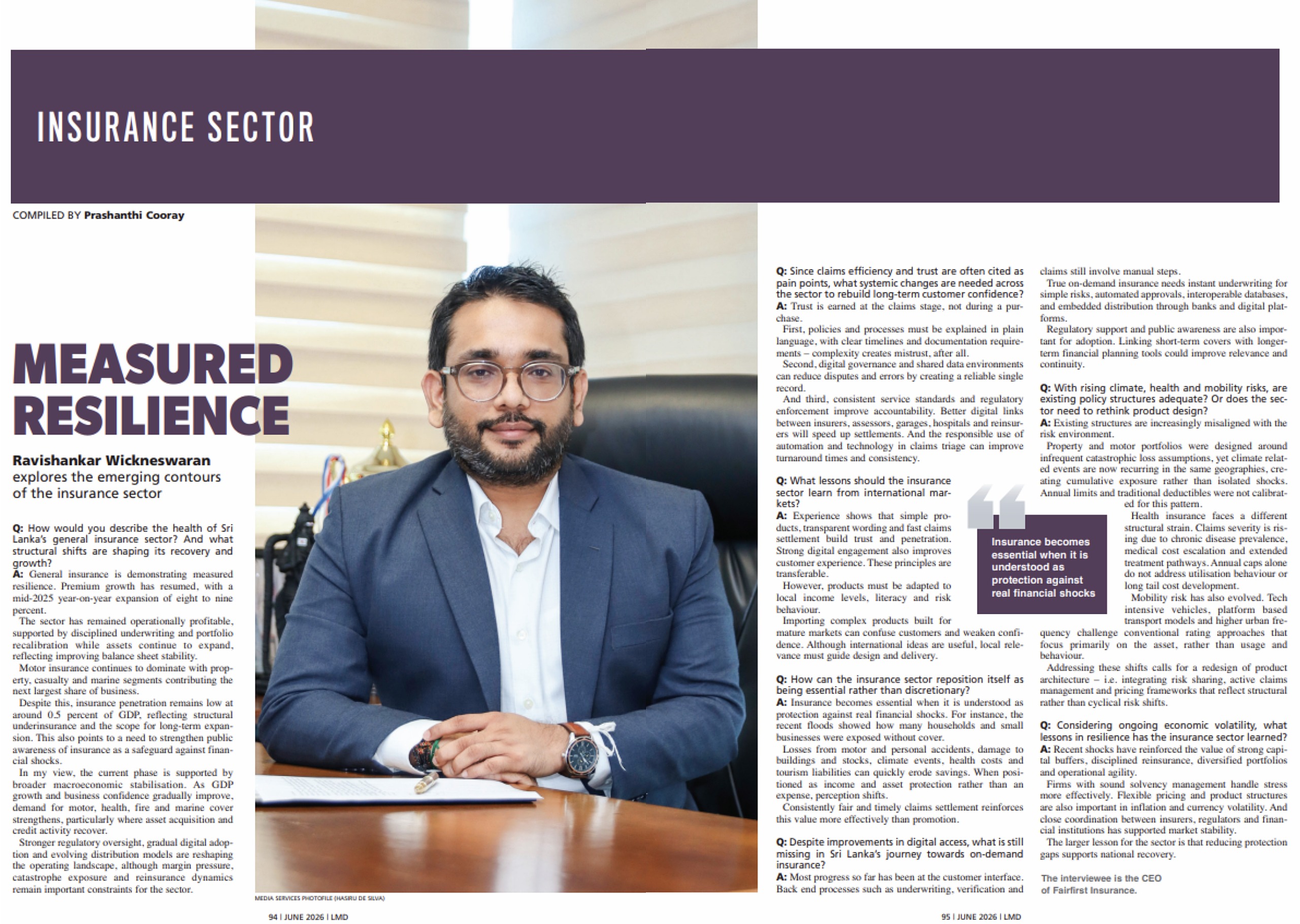
The interviewee is the CEO of Fairfirst Insurance.
Error: Contact form not found.


 Motor
Motor Travel
 Home Insurance
 Pet
Pet Health
 Smart Personal Accident
 Corporate
 Bicycle